Showing posts with label fabrics. Show all posts

Wednesday, January 18, 2012

Wear Your Heart On Your Sleeve


With Valentine's Day coming up in less than a month I thought I would do some pre-Valentine's wardrobe prep. Most of us girls look forward to this day with anticipation . This is one of those days that retailers take advantage of consumers selling the concept of love and romance. If I am like most girls, we look forward to dressing up and having a night on the town with our sweetie.

When I was in high school I was on an allowance that didn't always allow me extras for special occasions like Homecoming dances or white glove parties. I felt lucky I had learned how to sew at a very early age. I used my allowance to buy fabric and patterns to make the expensive fancy dresses for these special nights.

I made a few poor choices when combining pattern to fabric. I didn't always pay attention to the fabric recommendations on the label. I learned the hard way.

In the 70s and 80s Gunne Sax clothing was rather popular. 
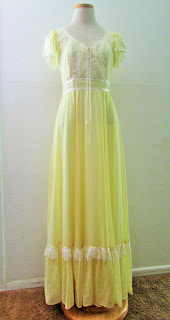
 Vintage 1970's Cotton Gunne Sax Dress
1970's Original Gunne Sax Coton and Lace Dress

Typically, the Gunne Sax styled dresses were made of cottons and calicos and trimmed in thin satin ribbon and lace. The Gunne Sax pattern I chose was a very 80s styled dress, big billowy sleeves and all.


I picked out a pink taffeta fabric, similar to the fabrics of special occasion dresses I saw in the stores at the mall. I was very excited to embark on my sewing project.

The laying out of the pattern, cutting and preparing to sew was the easy part. Let me first say, that taking on a Gunne Sax dress is ambitious. The dress contains many pieces, many ruffles and many tiny buttons holes. Things were going pretty good at the start, but once I got to the bottom ruffle(which was approximately 2 yards all on its own) I began having difficulty. The taffeta fabric I thought would make me a Cinderella type gown was letting me down. The edges of the fabric began fraying and I had to double stitch seams, which were possibly going to open once I was wearing it. The double seams worked but they did not solve the overall problem. There was also a problem trying to create tiny little loops for buttons down the front of the bodice, ugh!

I spent hours and hours on the dress- perhaps a good week and half of hours at night (after all my homework was done of course) prior to the dance- I even remember doing last minute stitching on the dress just a few hours before wearing it.

Here is the end result and yours truly at 15

Valentine's Day Dance 1983
I strongly suggest to you my readers to match your project to the proper fabric- There is a reason for the suggested fabrics. As you see in the photo- the end result was lovely and I had a lovely evening with my date; but unfortunately it did not store well and fraying continued and eventually it was given away.

I learned a lot from this project and think it helped me become a better seamstress.

Monday, January 2, 2012

Find That Fabric!

I have been accumulating patterns over the past year for many of my projects. One thing I like to do is take a part of one pattern and combine it with part of another to get the desired look I am after. I know this is not a new idea at all but I like to think that it is and after all is said and done I have an OOAK finished product. http://dictionary.reference.com/browse/one-of-a-kind  (Even after all these years on the internet and learning how to chat and text with less and less symbols; I still had to look this abbreviation up!)

After I have my project drafted by its design and color; I pursue the fabric. I don't know if anyone else ishaving a similar problem finding fabric and notions but all of the  fabric stores in my area are closing up. Blame it on the economy, blame it on lack of interest in the old fashioned art of sewing but needless to say- I can hardly find any fabric OR decent fabric in my neighborhood. Hancock Fabrics and Jo Ann stores were the 2 that I shopped at, AT least bi-monthly and during holiday season- almost weekly. Sad to say they are both gone and the only other fabric store close by is a remnants store which, in my opinion, is getting worse and worse each time I go in.

You know the saying "necessity is the mother of invention"? I have had to use it and become creative in ways to find fabric. My solution: sheets! Yes, I said sheets. Why you ask? Well first of all the twin size sheet is almost 4 yards of material, second you can find all colors, deigns, weights of cotton and or sizes (for more material). Third, and my favorite reason, you can buy sheets at thrift stores for mere pennies! There are thrift stores in my neighborhood that have half off day sales so you can get a complete set of sheets including pillowcases, flat and fitted sheets for less than $3.00!

I have been using sheets and pillowcases for some of my projects lately. I prefer the vintage percale sheets because they are a 50/50 blend of cotton and polyester and tend to wash and dry well without ironing or worry of shrinkage. I made this apron with a vintage Strawberry Shortcake pillowcase. It cost me $1.49 at Goodwill. The coordinating fabric was also found at another local thrift store as a fabric remnant for about $1.00. I already had the pink ric rac trim; so after about 2 hours of my time and a bobbin full of thread this apron cost me less than $4.00!

I have also found other ways to acquire material for my projects. I have been scouring websites day and night for Doctor Who themed fabric. I thought it had been commercially manufactured but evidently there never was any. I did find Doctor Who "inspired" fabric on this really cool website called Spoonflower.com      http://www.spoonflower.com/welcome It allows you to offer up a design for fabric and you can have it made and you can sell it to others in fat quarters, yards or bolts. However, because of the customization the by the yard price is rather steep, sometimes in the $30/per range.

Wednesday, August 4, 2010

Tag! You're it!

Labels and tags that are given to people are not always a good thing. Labels and tags for clothing, however; can tell you a story. When shopping for vintage clothing, one of the first things I look for on a piece of clothing is the label. Clothing tags give you the typical information: manufacturer, size, material, etc. If a size and material label are not found; then sometimes I can find an RN number.

RN stands for Registered Number. This means that the clothing manufacturer is registered with the US Federal Trade Commission. RN numbers are very helpful because it will link the piece of clothing to a designer or clothing line. From there, you can search the manufacturer’s years of production. There are several links online including a very informative link on one of my favorite websites: Vintage Fashion Guild
http://www.vintagefashionguild.org/component/option,com_alphacontent/Itemid,100

Not all clothing has tags or RN numbers; this is largely due to the fact that a lot of clothing that was made prior to 1970 was handmade. Handmade clothing is harder to date and identify but usually there are signs to help determine those characteristics. I was sewing on an old cast iron Singer before ever taking a home economics class. As a result, I think that I am more familiar with fabrics and textures than a lot of people nowadays. I am grateful for my interest in clothing at an age when you could choose from several textures and weights in fabric as opposed to the purely 100% cottons that you find at your local fabric stores today.

One thing I can almost always count on when dating fabric is that any heavy polyester or polyester knit fabric is ALWAYS geeky in appearance and ALWAYS 1970’s! But, “Hey”; I am almost always geeky in appearance so I don’t mind being labeled in that respect.

Friday, July 30, 2010

Fox In Socks

One of my favorite accessories is socks. Womens' and girls' socks have come a long way from the plain white cuffed style. However; I do keep at least a half dozen or so on hand and do wear them regularly with my black Mary Janes. By the by; socks aren’t usually trendy or emphasized by its parent fashion industry.

When I was growing up there wasn’t much selection when it came to socks. There were white cuffed, white ankle socks with little pom poms at the heel or boy’s striped tube socks (if you were a tomboy and played softball). Like I said, the sock industry has come a long way since the ‘70’s.

Nowadays, almost every retail store has at least 2 or 3 rows of socks in a wide variety of colors, shapes and designs. During the Christmas season you can get a pair of microfiber ankle socks that resemble candy canes or wool slipper socks with felt “Rudolph the Red Nosed Reindeer” faces looking up at you. I admit, these are impulse items but hey, I’m a sucker for impulse items.

I was visiting a local craft and fabric store the other day and came across several diy sock books. These books were not the run of the mill baby bootie designs. The patterns were cute, edgy and the designs looked as if they reached as far as your imagination could take you on a sock journey. One of the books that caught my eye is called Knitted Socks East And West. The pair of socks on the cover reminded me of ‘80’s leg warmers; but for your feet! They are super cute but I would never wear them because they expose your toes and mine are usually cold; even during the summer months.

In addition to my on hand supply of white cuffed socks I have several pairs of knee high socks: argyles, polka dotted, fishnet, opaque and dotted swiss as well as a plethora of solid colors. I work in a conservative environment where khaki pants and button down, cotton blouses usually make up the dress code. Since I have a lifetime of pushing the dress code boundaries, I have found that socks can give me a subtle edge to my outfit without being obvious.

Tuesday, June 22, 2010

Recycling Will Save The Pelicans


June 2, 2010

There was a time and a place when any well respected, properly dressed, modern woman NOT only wore stockings but she would carry around a spare pair in her purse, just in case. Stockings were made of silk and they averaged about $2.00 a pair, maybe more depending on where you shopped. Today, the average American pays more than $2.00 for their morning cup of coffee. In 1940, the average American household lived on less than $24.00 per week so if you got a snag in your stockings I’m not sure you could just go out and buy another pair of stockings without sacrificing some of the family’s monthly allowance. Then, on May 15, 1940 the Du Pont Company changed how the modern woman bought and wore hosiery. It was the first day that nylon stockings were sold retail!

I came up with the concept of this blog weeks ago and thought it would be fun to explore the world of “plastic” clothing. However, as I am typing it, gallons and gallons of crude oil continue to spill into the waters of the Gulf of Mexico and kill wildlife and seafood sources of the region. I now have writer’s remorse. I don’t want to give the impression that I support offshore drilling as a viable means to continue to produce synthetic clothing and textiles by writing about the fascinating world of nylon.

On April 20, 2010, a semi-submersible exploratory offshore drilling rig in the Gulf of Mexico exploded after a blowout and sank two days later, killing eleven (11) people and causing a massive oil spill threatening the coast of Louisiana, Mississippi, Alabama, Texas, and Florida The rig is owned and operated by Transocean, Ltd., on behalf of BP.

Now, as I re-read what I started to write; I ponder this notion; “Did Mr. Du Pont’s vision of re-creating a world of synthetic fibers and materials for clothing include killing off some of our world’s richest, natural resources?” In 1937 new and exciting studies on hemp were being introduced to society. These studies of hemp coincided with Mr. Du Pont patenting his creation, nylon. Over the years it has been argued that Mr. Du Pont paid millions of dollars to private organizations to create special groups that advocate the criminalization of the production of hemp and slander its positive qualities, especially its use as a fiber in textiles. Do any of the labels on your clothing say 100% hemp? I know I don’t have any. The majority of my wardrobe is created from a fabric made of blended synthetics and cottons. Supporting recycling and reuse of already manufactured clothing, such as vintage articles is a safer way to wear the fabrics of the future.

I pray that the oil executives will control the spill and cease the production of future spilling of oil into the Gulf very soon. I also pray that a new awareness of the idea: “You Are What You Wear” will surface and force the textile industry to re-think how fibers are used.